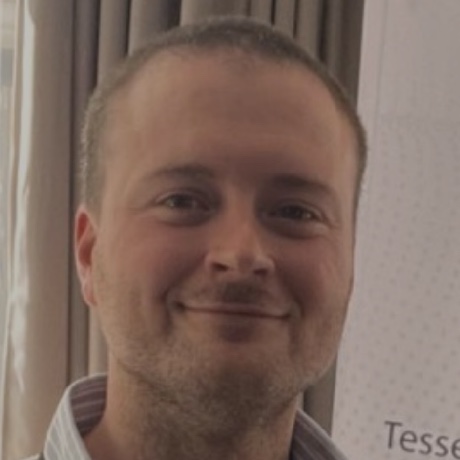
Portrait photograph of Fabio Rovai, AI researcher and data scientist

Fabio Rovai

AI Researcher and Data Scientist · London

I build systems that let machines reason about the world and prove that the reasoning holds. My work sits between formal methods and machine learning: causal verification for language agents, ontology engineering, and world models you can audit.

Formal rigour, applied to messy problems.

Fabio Rovai is an AI researcher and data scientist based in London, and co-founder of The Tesseract Academy. He holds an MSc in Data Science and Artificial Intelligence from the University of the Arts London, where he later taught as an Associate Lecturer for four years.

His research addresses a single question: how do you know an AI system's reasoning is sound? That question runs through all of his published work, from causal verification of agent actions before they execute, to ontology alignment that is provably stable, to event-graph substrates that support counterfactual queries.

Alongside the research, he leads applied engagements for public bodies and industry. He has worked as a researcher for the Alan Turing Institute on large language models in cyber defence, produced a published land valuation study for the Welsh Government, led an Innovate UK BridgeAI programme for the creative industries, and built ontology tooling for the National Digital Twin Programme.

He reviews for the NeurIPS ethics track and maintains a set of open-source tools in Rust and C for ontology reasoning, agent provenance, and document verification.
Publications

Preprint and commissioned work. All five preprints below are single-author and available in full on arXiv. Citation counts are tracked on my Google Scholar profile.

  1. 2026arXiv:2606.10934

    WorldKernel: A World Model is the Coupling Kernel of Admissible Possible Worlds

    Argues that observational and interventional data given to a strong enough predictor is not sufficient for counterfactual reasoning. Reframes a world model as a positive semidefinite coupling kernel over admissible possible worlds, where the diagonal is ordinary prediction and the off-diagonal carries the cross-world dependence a standard predictor cannot represent.

    cs.AI · 9 June 2026

  2. 2026arXiv:2605.09168

    CIVeX: Causal Intervention Verification for Language Agents

    A verifier that decides whether a tool-using agent should execute a proposed action, by mapping it to a structural causal query over a committed action-state graph and returning an auditable verdict: execute, reject, experiment, or abstain. Reports zero observed false executions under moderate and adversarial confounding.

    cs.AI · cs.LG · 9 May 2026

  3. 2026arXiv:2605.09184

    Open Ontologies: Tool-Augmented Ontology Engineering with Stable Matching Alignment

    An open-source Rust system pairing LLM-driven ontology construction with formal OWL reasoning and alignment over the Model Context Protocol. Stable one-to-one matching is shown to be the dominant factor in alignment quality, reaching F1 of 0.832 on the OAEI Anatomy track.

    cs.AI · cs.CL · cs.DB · 9 May 2026

  4. 2026arXiv:2605.15967

    Deterministic Event-Graph Substrates as World Models for Counterfactual Reasoning

    Treats a deterministic event graph as the substrate of a world model, so that counterfactual questions become graph queries with defined answers rather than sampled generations.

    cs.AI · cs.CV · cs.LO · 15 May 2026

  5. 2026arXiv:2605.23983

    Saturating Scaling Laws for Equational Discovery

    592 runs across three toy substrates plus two real-world replications, testing a mean-field model of saturating power-law growth. Finds that growth dynamics are substrate-conditional and do not generalise across domains.

    cs.AI · cs.LO · cs.SI · May 2026

Commissioned and government research

  1. 2026Welsh Government

    Testing land valuation methods: Tesseract Academy

    Published by the Welsh Government on 17 March 2026 as part of its land value tax evidence programme. Tests five valuation approaches, including market-based statistical valuation and machine learning applications.

    Published 17 March 2026 · GOV.WALES

  2. 2025Alan Turing Institute

    Large language models in cyber defence

    Research on reinforcement-learning language agents in emulated networks for threat detection, carried out under a formal research services agreement with the Alan Turing Institute. Report under review.

    Research engagement, December 2023 to January 2025

Software

Tools I build and maintain in the open.

Selected roles

Get in touch.

For research collaborations, speaking, advisory work, or anything involving ontologies and verifiable AI.